
GitHub proposed charging for the Actions control plane, then backed off after community backlash. At the same time, services like Blacksmith can run CI machines faster and cheaper while GitHub still brokers the workflow. GitHub charges for the parts it still controls.
DHH should move Rails off GitHub. The tooling isn’t ready—but moving Rails would make it ready.
How I got here: I switched our CI from GitHub-hosted runners to Blacksmith a few months ago. After 30 days, the results were clear:
- Vitest: 7min → 3min (57% faster)
- Lint: 5min → 1.5min (70% faster)
- Cost per minute: $0.0061 → $0.004 (34% cheaper)
We went from $75/month to $67/month—while running 35% more CI jobs. Switching was trivial—change one line in your workflow YAML and you’re done.
Then Blacksmith sent me this:
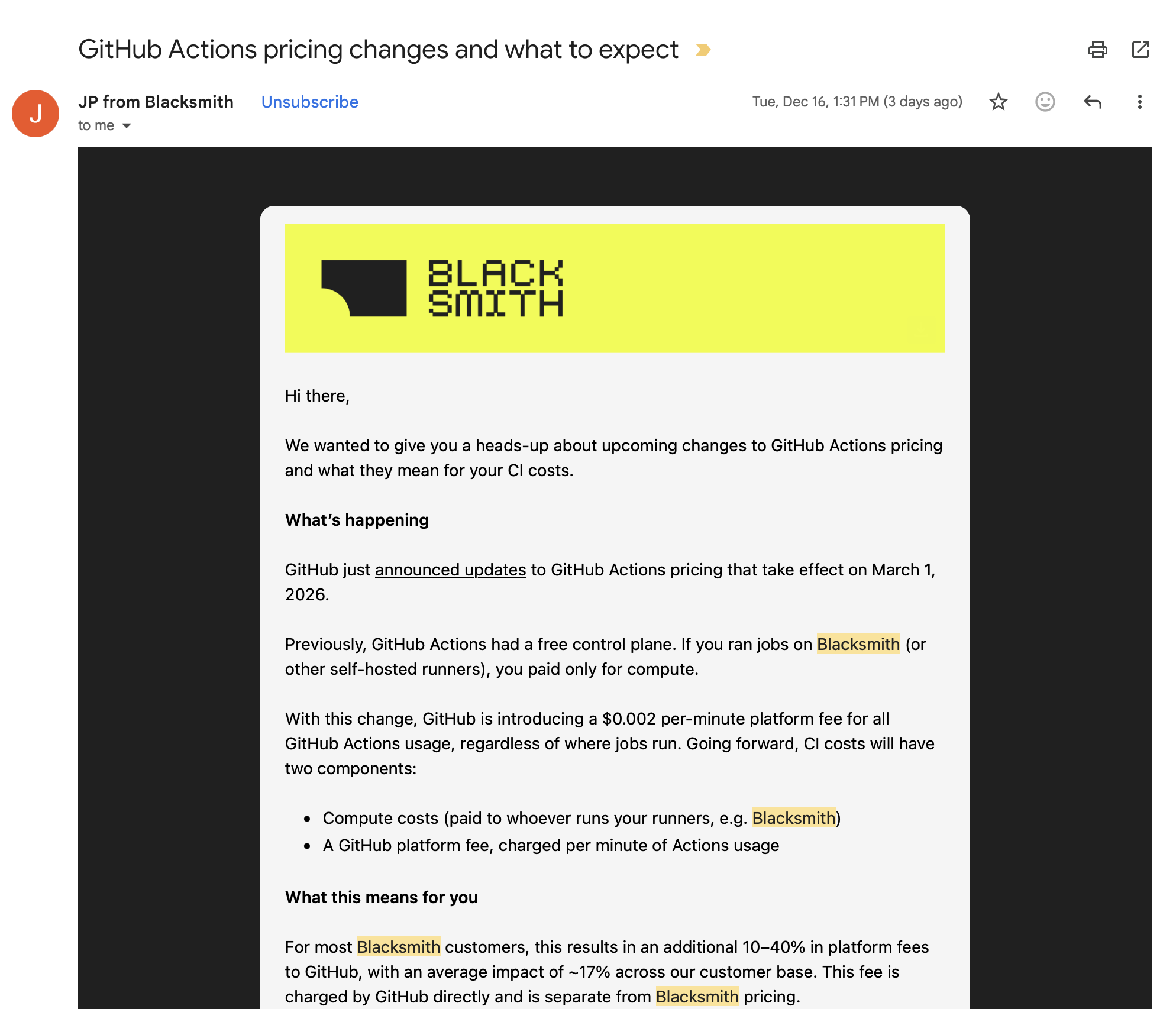
GitHub’s new control plane charges would wipe out those savings, even though Blacksmith was still faster. Not because Blacksmith got worse, but because GitHub decided to charge for the YAML parser and orchestration layer we were still using.
GitHub Is Being Unbundled
My team switched to Linear in a week. Not mandated—it was just better. GitHub is getting pulled apart: Linear for workflow, Blacksmith for compute, Codeberg for hosting. Microsoft moved GitHub into CoreAI—they care more about GitHub’s AI moat than its developer tools.
The incentives have shifted:
- Blacksmith makes money when your builds get faster
- Linear makes money when your workflow gets better
- GitHub increasingly makes money when you can’t leave
The Open Source Problem
Everything I described above is possible because I work at a startup. We can pay for Blacksmith. We can pay for Linear. We can stitch together better tooling because better tooling makes us faster.
Open source doesn’t have that luxury. If Rails wanted to leave GitHub tomorrow, what would they use?
Git hosting: Codeberg (running Forgejo) is the most credible community-first destination. But it’s a nonprofit running on limited resources.
CI: Codeberg offers Woodpecker and Forgejo Actions, but their docs explicitly mention resource limits and recommend self-hosted agents for heavier workloads. Rails-scale CI would require real infrastructure.
Issue tracking: Linear doesn’t fit. On the free plan, you can’t create new issues once you’re over ~250. That’s a non-starter for Rails (and most large OSS projects). Linear isn’t designed for public contributor workflows.
Zig’s Move Off GitHub
Last month, Zig moved off GitHub. Andrew Kelley didn’t write a polite migration post. One line stands out:
“GitHub Actions started ‘vibe-scheduling’…”
His point wasn’t “CI is slow.” It was “CI is unreliable enough that a major language can’t consistently validate its own master branch.” They also cite GitHub’s aggressive Copilot push nudging contributors into violating Zig’s strict no-AI policy—GitHub’s strategy actively degrading contribution quality for a project that explicitly doesn’t want it.
Zig didn’t just move code hosting—they’re asking donors to move off GitHub Sponsors to Every.org. When project leads are this publicly furious, it gives others permission to leave.
DHH’s Pattern: Build the Exit
GitHub is a Rails app—a Ruby on Rails monolith since the beginning. It was the Rails success story. Now that same platform feels slow and enterprise-first—more interested in taxing you than shipping for you.
DHH doesn’t just complain about platform lock-in. He builds exits and drags his company along. Over the last year he’s done a public OS journey—macOS → Windows → Ubuntu → Arch—and built Omakub and Omarchy to drag 37signals along with him. Moving Rails off GitHub would be the same playbook, but bigger.
Why Rails Matters
Five years ago, leaving GitHub meant your project disappeared. Zig just did it and their community followed. But Zig is still niche.
Rails isn’t niche. Rails is infrastructure. If github.com/rails/rails became codeberg.org/rails/rails, Forgejo would get real funding, CI solutions would appear, and the path would get paved for everyone else. Rails moving would make leaving thinkable.
I’ll admit: this is more bet than observation. I’ve routed around GitHub at my startup, but I haven’t tried Rails-scale OSS on Codeberg. For some teams, GitHub’s “good enough everywhere” still beats “best-in-class but stitched together.” I’d feel differently if GitHub started acting like a company that wants to win on product instead of lock-in. That’s not the trajectory I see.
What am I missing? If you’ve run large OSS projects off GitHub, I want to hear what broke.
Process note: This post was drafted from voice memos and notes. AI was used for transcription and structural editing. All links and claims were verified by me; mistakes are mine.